UL/cUL 1598 Hotel Lighting Compliance Guide: Technical Procurement and AHJ Approval
Avoid hotel opening delays. Verify UL/cUL 1598 compliance, evaluate Class 2 drivers, manage thermal limits, and prevent critical AHJ rejections.
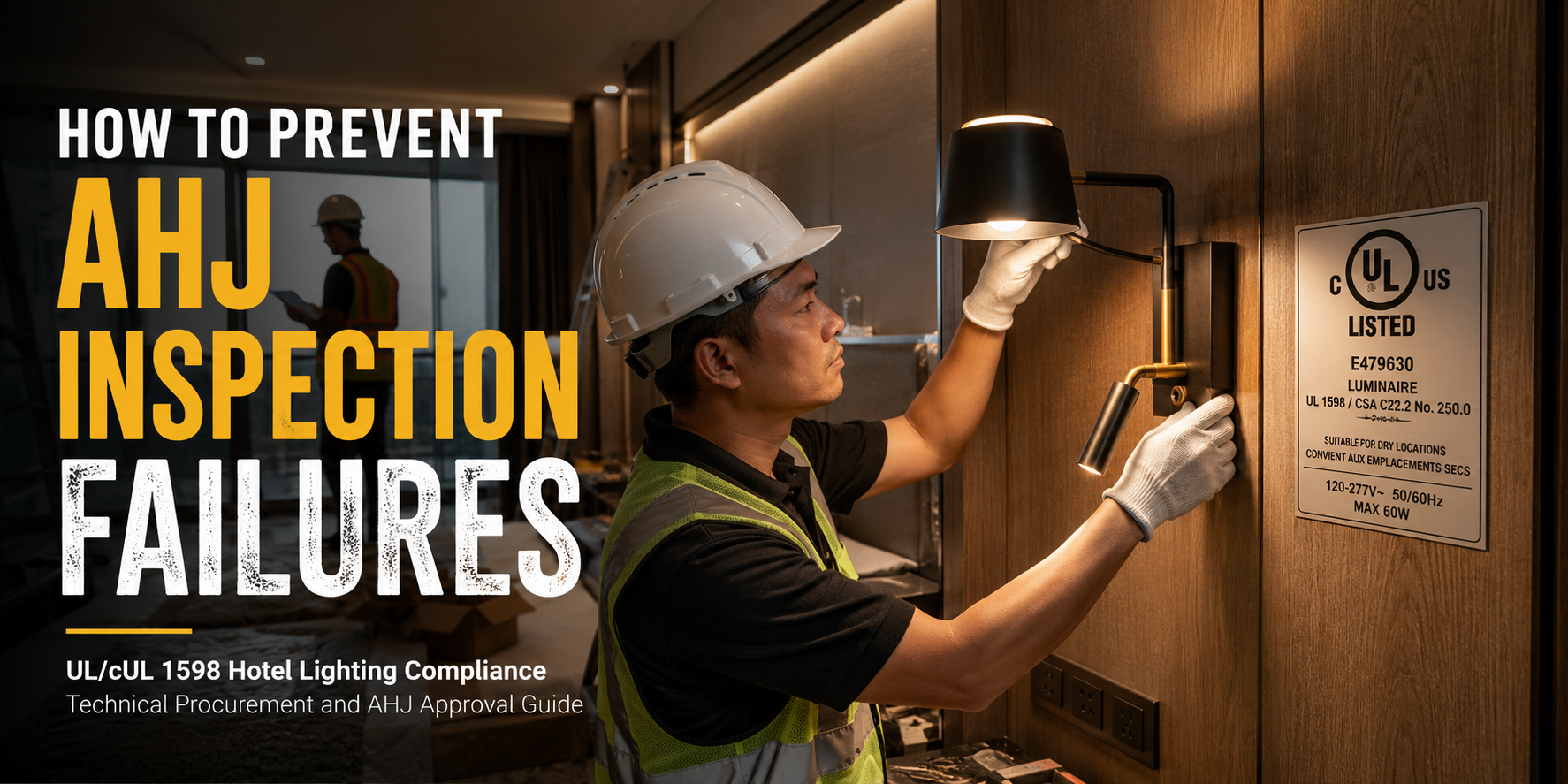
UL/cUL 1598 Hotel Lighting Compliance Guide: Technical Procurement and AHJ Approval
In North American hospitality construction, lighting fixtures sit on the critical path of final project closeout. Under the National Electrical Code (NEC) and Canadian Electrical Code (CEC), luminaires installed in commercial properties must comply with regional safety standards before a property can receive its Certificate of Occupancy.
For hotel developers, procurement teams, and electrical consultants, understanding UL/cUL 1598 compliance is not a formality. It is a direct factor in whether a project opens on schedule.
What Is UL/cUL 1598 in Hotel Lighting?
UL/cUL 1598 is the bi-national safety standard governing fixed, general-purpose luminaires installed in commercial and public buildings across the United States and Canada. It regulates the structural integrity, electrical insulation paths, mechanical strength, and thermal boundaries of lighting equipment.
In commercial hotel projects, a valid UL/cUL listing is a mandatory prerequisite for three critical approvals:
- AHJ (Authority Having Jurisdiction) inspection sign-off
- Electrical code compliance under NEC Article 410 and CEC Section 30
- Certificate of Occupancy (CO) issuance
Fixtures that lack a verified UL/cUL listing are routinely rejected during the initial submittal review phase or failed during physical on-site inspection, directly delaying hotel opening schedules and putting brand capital expenditure at risk.
Why UL/cUL Compliance Is Required in Hotel Projects
In North American hospitality construction, decorative and architectural lighting is integrated into the official building approval chain. Residential-grade lighting cannot be substituted because commercial spaces operate under significantly more demanding conditions.
UL/cUL 1598 compliance verifies three critical engineering boundaries:
Electrical safety. The standard mandates dielectric voltage-withstand testing (hi-pot testing at 2× Rated Voltage + 1000V) to confirm zero insulation breakdown or shock hazard on exposed metal surfaces.
Thermal safety. It verifies that internal junction temperatures stay safely below critical limits under continuous 24/7 guestroom or public area operation.
Mechanical integrity. It confirms that articulated joints, swivels, and aluminium mechanical swing arms can withstand repetitive guest interaction without sagging, loosening, or exposing internal wiring.
Without compliant, verifiable manufacturer documentation, commercial projects cannot pass AHJ inspection even when all structural and interior construction is complete.
What Happens If Lighting Is Not UL Listed?
Specifying non-UL listed or unverified decorative fixtures creates three distinct bottlenecks in the B2B supply chain.
1. Technical Submittal Rejection
Before a purchase order is placed, electrical consultants, MEP engineers, and engineers of record review all fixture datasheets. Incomplete or missing NRTL (Nationally Recognized Testing Laboratory) listing information results in immediate submittal rejection, stalling the procurement timeline before production begins.
2. On-Site Installation Delay
Electrical contractors and field installers are legally bound by local union codes and OSHA regulations. They will refuse to wire or mount non-approved luminaires in regulated commercial zones to avoid liability exposure.
3. Final Inspection Failure
During the final walk-through, AHJ inspectors cross-reference the physical labels on the fixture chassis with the approved electrical plans. Discovering unlisted equipment results in a failed inspection report and forces removal of the affected fixtures.
The operational result in all three cases is the same: delayed hotel opening. Every week a property sits unopened due to lighting remediation costs significant lost room revenue and operational overhead.
Common Hotel Lighting Compliance Issues
The following failure points appear most frequently during hospitality submittal reviews and final building closeouts.
| Issue | Project Impact | Engineering Consequence |
|---|---|---|
| Missing UL file or listing number | Immediate submittal rejection | Procurement cycle restarts; approval loops freeze |
| Voltage mismatch (120V vs 277V) | Major redesign required | Component burnout or failure on commercial 277V grids |
| Dimming incompatibility | Installation delay and acoustic noise | Cross-talk between TRIAC and 0-10V systems causes driver flicker |
| Unlisted secondary driver | Final inspection failure | USB or wireless charging subsystems fail safety isolation |
| Incorrect chassis labeling | On-site AHJ rejection | Physical label fails to match submitted documentation |
When UL Compliance Affects the Hotel Project Timeline
UL/cUL compliance functions as a strict gating mechanism across multiple phases of construction and fit-out. Missing or inconsistent documentation at any checkpoint will freeze the approval loop and force the submittal cycle to restart.
| Project Phase | Core Engineering Focus | Critical Compliance Risk |
|---|---|---|
| 1. MEP Design Review | Verifies driver specifications, voltage inputs (120V vs 277V), and dimming system protocols against the primary electrical design drawings | Driver incompatibility: specifying residential-grade or unlisted drivers that fail to interface with commercial building automation systems |
| 2. FF&E Submittal Approval | Reviews finalized shop drawings, fabric shade flammability certifications, and active NRTL listing files against hotel brand standards | Component-level gaps: undocumented secondary modifications such as uncertified USB or wireless charging modules added during sampling |
| 3. Electrical Inspection (AHJ) | Conducts on-site field audits of physical grounding continuity, enclosure integrity, and permanently affixed factory labels | Labeling discrepancies: chassis markings failing to match the certified file numbers on signed-off submittals |
| 4. Final Occupancy Approval | Performs the final cross-trade electrical walkthrough required to legally issue the Certificate of Occupancy | Project closeout stalls: discovery of unlisted fixtures forcing immediate removal and cascading delays to the opening schedule |
What Documents Are Required for UL Compliant Lighting?
A fully compliant technical submittal package requires five verified engineering assets.
Active UL/cUL file number. A direct tracking link to the NRTL online database confirming current factory compliance status.
Driver specification sheet. Explicit documentation of driver topology, specifying a Class 2 isolated driver with an integrated galvanic barrier to restrict output voltage to 60V DC or below.
IES photometric files and color data. Formatted photometric layout files (.ies) for architectural space lighting calculations, paired with integrating sphere test reports confirming color deviation is controlled within a 3-Step MacAdam Ellipse (SDCM 3 or better).
Voltage and dimming compatibility matrix. Confirmed electrical testing data showing smooth, continuous dimming performance down to 1% or lower without harmonic distortion or electromagnetic interference affecting in-room Wi-Fi networks.
Dimensioned installation drawings. Clear structural schematics detailing grounding points, terminal blocks, and mechanical mounting provisions for the electrical contractor.
What Causes Lighting Submittal Rejection?
Beyond a missing certification mark, technical submittals are frequently rejected due to more specific execution failures.
Component-level listing gaps. Using a listed LED chip paired with an unlisted driver, or integrating uncertified subsystems such as flat wireless charging modules embedded in a metal base. Each secondary electrical subsystem must maintain its own independent compliance status within the final assembly via internal structural isolation shields.
Incomplete chassis labeling. Failing to specify how the factory permanently marks the fixture with voltage, frequency, wattage, and the testing laboratory mark in a format acceptable to field inspectors.
Fabric shade thermal failures. Using decorative textile shades without flame-retardant backing, or without verified thermal performance under sustained bulb heat chamber testing. Premium shades must utilize a clean, rolled-edge technique over an inner styrene lining to avoid adhesive breakdown and fraying under continuous heat exposure.
Surface finish documentation gaps. Specifying a metal finish without providing resistance data for commercial cleaning agents. Brushed brass and anodized aluminum finishes used in guestroom environments should be treated with a hydrophobic anti-fingerprint and oil-resistant coating to protect the finish and withstand standard hospitality maintenance protocols.
Why Hotel Procurement Teams Prioritize UL Compliance
Experienced hospitality procurement teams evaluate UL/cUL 1598 as a primary risk control factor rather than a technical formality. The practical questions they are managing include:
- Will this fixture pass the physical on-site audit without requiring expensive field modifications?
- Will missing documentation push back the property's revenue-generating opening date?
- Will a component failure force the contractor to open finished drywall or ceilings to replace drivers?
- Will the MEP engineer approve this datasheet on the first review pass, allowing immediate manufacturing release?
Each of these questions has a direct cost implication. The earlier in the project cycle that compliance is confirmed, the lower the cost of any necessary correction.
For technical submittal inquiries or to request localized cUL/UL 1598 test data sheets, contact the Minoze Lighting engineering team at simon@minozelighting.com.
Frequently Asked Questions
What is the difference between UL Listed and UL Recognized for hotel lighting?
A UL Recognized mark indicates that an individual component, such as a driver, switch, or socket, is safe for use inside an assembly. A UL Listed mark certifies that the complete, fully assembled fixture has been tested and approved as a finished product. Hotel inspectors and electrical consultants require the complete fixture listing, not individual component recognition. A fixture built from UL Recognized parts that lacks an overall product listing can be legally rejected during installation.
Is ETL certification acceptable instead of UL for hotel projects?
In most U.S. commercial projects, ETL and UL are both Nationally Recognized Testing Laboratories (NRTLs) regulated by OSHA. Both test to the same ANSI safety standards and are legally equivalent from a regulatory standpoint. However, some hotel brands or ownership groups specifically require UL certification in their brand standard manuals. This requirement must be identified during the initial bidding phase, not after production has started.
What voltage configurations do hotel lighting fixtures need to support?
North American hotels operate on both 120V and 277V electrical systems depending on the circuit and application. Fixtures specified for commercial hotel use must be verified against the site's actual electrical configuration. A fixture rated only for 120V can fail or be damaged on a 277V circuit, creating both a safety issue and a procurement replacement problem late in the construction schedule.
Why do compliance issues appear late in hotel projects rather than early?
Most certification problems are introduced during the engineering and sampling phase when designs are still evolving. A fixture may pass initial review, then receive a driver substitution, an added USB charging port, or a factory wiring revision during the production phase. If the compliance documentation is not updated to reflect these changes, the discrepancy will not surface until contractor submittals are reviewed line by line, often when guestrooms are already under construction.
How early should UL compliance be confirmed in the procurement cycle?
Compliance documentation should be confirmed at the same time the fixture design is finalized, before mass production begins. Waiting until shipment to verify certification is one of the most common causes of last-minute inspection failures in hotel FF&E projects. Aligning engineering revisions with documentation updates throughout the sampling phase eliminates the most frequent sources of late-stage submittal rejection.
Final Thoughts
A UL/cUL 1598 listing is not simply a label on the back of a fixture. In hospitality projects, it is a verified document that determines whether a product can clear contractor review, pass field inspection, and contribute to an on-schedule opening.
Compliance problems in hotel lighting rarely appear at the start of a project when timelines are still flexible. They appear at the end, when guestrooms are under construction, installation crews are already on-site, and the cost of any correction is at its highest.
Treating certification as an active part of product engineering throughout the sampling and production phase, rather than administrative paperwork to handle at shipment, is the most reliable way to keep a hospitality project on schedule from design approval through final inspection.
For technical submittal inquiries, contact the Minoze Lighting engineering team at simon@minozelighting.com